If you’ve ever seen people online talk about “U-spot stimulation,” you might wonder: Is this a real thing? Where is it? And why do some people swear by it while others feel nothing—or just feel like they need to pee?
Here’s the simplest, most grounded way to think about it.
1) First: the “U-spot” isn’t a magic button
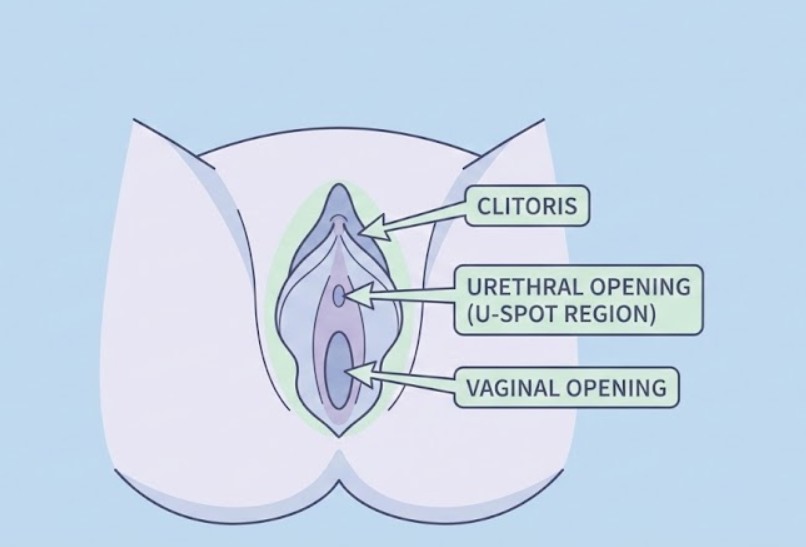
“U-spot” is not an official, universally agreed medical term. It’s more of an internet/sex-education nickname people use to describe a sensitive area around the urethral opening (the pee hole) and the front part of the vaginal entrance.
So instead of picturing a tiny dot you must “find,” imagine a small region near the urethra and vaginal opening that some people find especially responsive.
2) Where is it, roughly?
In everyday language:
-
The urethral opening sits above the vaginal opening.
-
The “U-spot” usually refers to the area around that urethral opening and the surrounding vestibule (the skin/tissue right around the vaginal entrance).
That’s it. No mystery map required.
3) What does it feel like?
People commonly describe two main types of sensations:
A) “I really need to pee”
This is super common—and not weird at all. The urethra and nearby tissues are tied into the bladder/urinary system, so stimulation in that area can send “urinary” signals.
B) A strong, building sensation that can turn pleasurable
Some people feel a mix of pressure + warmth + tingles that can become arousing, especially when they’re relaxed and not rushing.
Important note: Feeling pee-ish doesn’t automatically turn into pleasure. For many people, it stays pee-ish. That’s normal.
4) Why do some people love it and others don’t?
A few reasons:
-
Body differences: Nerve distribution and tissue sensitivity vary a lot person to person.
-
Arousal level: If someone isn’t warmed up or is tense, the area may feel irritating instead of nice.
-
Mindset: Worrying about “am I going to pee?” can make it harder to relax.
-
Technique: Too much pressure or friction can easily tip into discomfort here.
Basically: this is one of those “depends on the person” zones.
5) Is this the same as the G-spot or squirting?
People often mash these topics together online, but they’re not the same thing.
-
“U-spot” talk is usually about the urethral area near the vaginal entrance.
-
“G-spot” (also debated) is usually described as a deeper area on the front vaginal wall.
-
“Squirting” is complicated and varies widely, and not everyone experiences it—and it’s not a “goal” anyone needs to chase.
They’re near-ish in anatomy, so discussions overlap, but they’re not identical.
6) The most important part: comfort + hygiene
Because the U-spot area is very close to the urethra, it’s also an area where people can get irritation—or even urinary discomfort—if things get rough or messy. A few easy safety tips:
-
Clean hands, trimmed nails: This area is sensitive. Little scratches matter.
-
Use lube if needed: Less friction = less irritation.
-
Go gentle: Light pressure and slow exploration usually works better than intense rubbing.
-
Pain is a stop sign: Sharp pain, burning, or lingering soreness isn’t “normal to push through.”
-
Watch for UTI signs afterward: Burning when peeing, urgent/frequent peeing, lower belly discomfort—take it seriously and consider medical advice.
-
Avoid cross-contamination: Don’t move from anus → urethra/vaginal area without cleaning/changing barriers.